
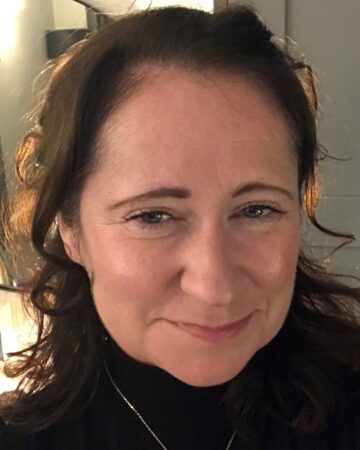
Sheila McGovern

Caroline Dickson
Stories that Shape Us
By Sheila McGovern and Dr Caroline Dickson
“After nourishment, shelter and companionship, stories are the thing we need most in the world.”
― Philip Pullman
We love a good story, and Philip Pullman, who wrote ‘His Dark Materials’, is as good a storyteller as any, which is why we chose his quote above. However, we believe that stories can also act as nourishment, shelter and companionship.
From the very earliest days of human history, even before we had written language, storytelling has been one of our strongest ways to connect with each other, share our values and grow as human beings. They have also offered us ways to make sense of the world around us, pass on our wisdom and build relationships. In whatever way they are presented: spoken word, books, movies or podcasts, stories offer us a medium to share experiences that draws us together.
 This spring we will be celebrating nurses’ stories by sharing them through a regular podcast. The podcasts are brought to you by the Foundation of Nursing Studies in collaboration with ListenUpStorytelling and will take the form of a mini-series. The aim of the Person-centred Nursing podcast is to offer nurses space to share their stories to support professional learning, identity, wellbeing and the creation of healthful workplace cultures. The first series, ‘Stories that Shape Us’ will share experiences of person-centred moments in practice, from nurses and midwives from across the UK.
Working in healthcare is complex; time pressures and clinical priorities can sometimes overshadow personal connections and wellbeing. Storytelling offers a way to reconnect with what it means to care for one another. Stories allow us to step into someone else’s experience and perhaps get a glimpse of their inner landscape. When we do that, we nurture empathy and compassion and make connections on a deeper level. By listening to and valuing people’s stories, we, as healthcare professionals, can gain deeper insight into the experiences, emotions and meaning that cannot be captured by data or diagnostics alone. We can learn about the experience as well as the event.
As nurses and midwives, we carry with us stories from the people we care for, stories of challenge, growth, trauma and resilience. Caring work is a deeply human experience for all people involved and is often, as we know, emotionally demanding.
Person-centredness, person-centred care and person-centred practice are all terms nurses use every day in their work, but would we recognise this if we saw it in practice? Would we recognise it if we experienced it?
Stories that shape us, the first mini-series of podcasts will feature a podcast a month for six months beginning in late May 2026. In this series we will shine a light on person-centred moments with nurses from across specialties; and reflect on how these experiences nurture and shape us and those that we care for.
We will share details of how to listen to our podcast closer to the time: Stay tuned!
Background
Our understanding of person-centredness is informed by the work of Brendan McCormack, Tanya McCance and others as it resonates with storytelling (McCormack and McCance, 2017; McCormack et al., 2021). Like storytelling, person-centredness is emancipatory in its intention, aiming to create democratising, empowering and liberating workplaces (Titchen, 2018). This approach is achieved through respect, authenticity, caring, sharing autonomy and human agency.
Similarly, storytelling theory is rooted in activism, highlighting the need to hear the voice of all persons, emphasising people’s strengths and personal intention in sharing their stories. Democratisation of voice is fundamental to Joe Lambert’s work (Lambert and Hessler, 2020). Joe founded Storycenter in the 1990s and suggests we use stories to make sense of the world and to create emotional connections with others through experiences. He also proposes that storytelling supports the continued construction of a healthy individual identity. His work has been used to foster community and cultural engagement, using emotional resonance and empathy.
The method of storytelling we use is applied storytelling, informed by Smets, Troup and colleagues’ work. Their definition explicitly advocates for a person-centred approach:
“applied storytelling is person-centred which means the autonomy, needs and voices of the participants are of central importance and drive the direction of work. It is also strengths-based, meaning power, expertise and knowledge are innate and exist already in the participants.” (Kepes Alapítvány et al., 2022)
References
Lambert, J. and Hessler, B. (2020) Digital Storytelling: Story Work for Urgent Times Available at: https://www.storycenter.org/inventory/p/digital-storytelling-story-work-for-urgent-times
Kepes Alapítvány; Mythos; The Village Storytelling; Settle Stories; and Storytelling Centre Amsterdam (2022) All future is fictional: Story telling toolkit. Available at: https://53c5bd92-5225-4151-b79f-57128a723518.filesusr.com/ugd/375145_c98e316349e14b90b11462c81a436f3b.pdf
McCormack, B., McCance, T., Bulley, C. et al. (Eds) (2021) Fundamentals of Person-centred Healthcare Practice. Wiley Blackwell.
McCormack, B. and McCance T. (Eds) (2017) Person-centred Practice in Health and care: Theory and Practice. Wiley Blackwell
Titchen, A. (2018) Flowing like a river: facilitation in practice development and the evolution of critical-creative companionship. International Practice Development Journal 8(1):1-23. DOI:10.19043/ipdj.81.004