

 Why we chose RBCS for the professional supervision of parish nurses and how it’s worked out
By Anne Taylor, Director of Nursing, Parish Nursing Ministries UK
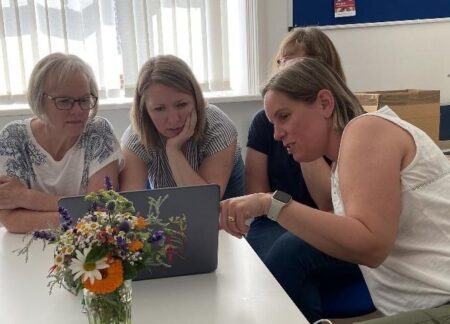
PNMUK Regional Nurse Coordinators July 2024
Parish nurses practice autonomously and are often the only parish nurse in their neighbourhood. Recognising the potential for this to lead to professional isolation, Parish Nursing Ministries UK (PNMUK Parish Nursing Ministries UK) offers quarterly professional supervision within regional Communities of Practice (CoP) to all practising parish nurses in the UK. These supervision sessions have proven invaluable to parish nurses as a safe space to discuss and reflect on their practice, share learning and news and find fellowship amongst colleagues. One parish nurse reflected, “CoP meetings support parish nurses with any concerns, particularly, as we are generally lone workers. Our meetings are educational and relevant in maintaining our nursing registration with the NMC. Our knowledge is enhanced in delivering the best possible care to our clients. Networking with other parish nurses is a huge benefit within our role in sharing and learning from others’ experiences”.
These Communities of Practice are facilitated by PNMUK Regional Nurse Coordinators. Having observed our Coordinators as they facilitated CoPs, I was impressed by their wise use of nursing skills to establish safe confidential spaces, reflect on practice and draw learning from experience. But I was keen to identify an evidence-based framework for supervision to affirm and standardise the supervision.
Perhaps not to my surprise given my own patchy experience of receiving and providing supervision in previous roles, I found a scarcity of frameworks for the facilitation of professional supervision in nursing, Resilience-based Clinical Supervision (RBCS) being the exception. RBCS is a proven tool, evidence based and akin to our current practice at PNMUK. In addition, I was interested to read that the underlying theory of compassion-focused therapy (Gilbert, 2010, which you can read about in the Facilitator Companion) was developed with and for people with high levels of self-criticism. Parish nurses hold themselves to extremely high standards and can be self-critical when they cannot provide more than what is already above and beyond.
Two other features of RBCS made it a particularly good fit for use in parish nursing; firstly the process and also the consideration of facilitators’ wellbeing. Parish nurses are deeply motivated by faith and bring extensive experience of grounding through meditation and prayer. The fit here with RBCS was clear. Secondly, the importance of self-care is explicitly recognised in the parish nursing model given the potential for self-neglect amongst faith-motivated nurses in positions of autonomy and therefore with little to check their inclination to give without heed for their own wellbeing. A framework therefore that incorporates the care of the facilitator in addition to that of the participant was a very positive feature of RBCS for me.
In 2024 we organised a programme for Regional Nurse Coordinators to introduce RBCS, which we launched in practice at our annual national Symposium in September 2024. Late in 2025, Regional Nurse Coordinators evaluated RBCS as a framework for supervision. Full standardisation is yet to be achieved, and it was recognised that familiarity with the framework took time. However, benefits identified include moving discussions from being task-based or descriptive to being about wellbeing and learning from practice, enabling the CoP members to build as a team and focus on the Code whilst also shedding light on how parish nurses feel about issues in practice. In one case RBCS was seen to be instrumental in “a light switch” moment for a parish nurse and being a “good tool” for addressing issues.
In looking to the future, we have identified alternative check-in tools which will be evaluated at our next annual review of RBCS at the end of 2026.